



















NASA’s plan to build a Moon Base starts with these rovers

THE TAKEAWAY
When NASA announced its ambitious, out-of-this-world plans to build humanity's first base on the moon, many wondered the same thing: how? Now, new renderings offer a glimpse at the rovers and technology that could help make the groundbreaking lunar outpost a reality.
NASA is offering a closer look at its state-of-the-art lunar terrain vehicles and rovers, both robotic and crewed, designed to map the moon’s rugged surface, search for essential resources and transport astronauts.
The agency said the rovers will play a critical role in the early development of its Moon Base initiative by gathering data and testing the necessary technology needed to help astronauts live and work on the lunar surface.
NASA highlighted three lunar vehicles: the robotic VIPER rover and two crewed lunar terrain vehicles being developed under NASA contracts.
AMAZON’S DELIVERY DRONES ARE BUILT TO FLY THROUGH RAIN, EXTREME HEAT AND FREEZING TEMPERATURES
This snake won't slither across the moon's surface, it'll do something far more impressive.
NASA's VIPER (Volatiles Investigating Polar Exploration Rover) is designed to explore the moon’s South Pole, searching for water ice and other resources that could support future human missions.
VIPER is scheduled to travel to the moon in 2027, where it will explore permanently shadowed craters near the lunar South Pole in search of water and other resources.
On its moon mission, the rover is expected to travel more than 18 miles while studying the region’s lighting, terrain and thermal environment.
NASA’S MARS ROVER REACHES MAJOR MILESTONE WITH RECORD-BREAKING JOURNEY
NASA’s Ames Research Center in Silicon Valley will oversee VIPER’s mission while teams simulate potential lunar scenarios.
The fully assembled rover is undergoing final testing at NASA’s Johnson Space Center in Houston before traveling to Florida’s Kennedy Space Center for launch, NASA said.
The wheels are in motion, and NASA astronauts will be riding in style in outer space.
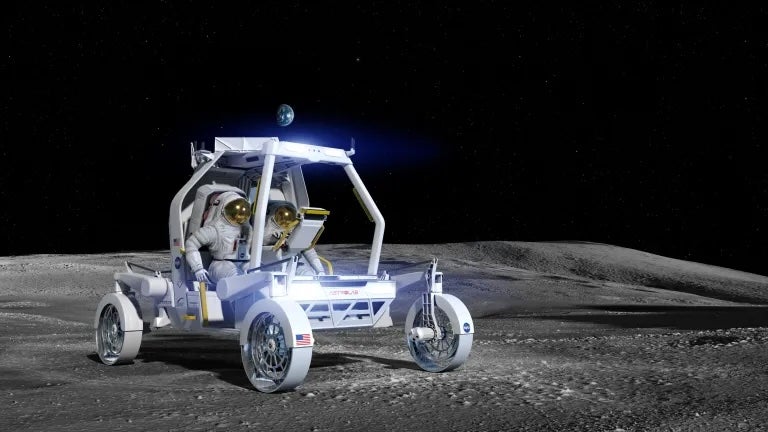
The agency is working with Astrolab and Lunar Outpost to develop larger lunar terrain vehicles (LTVs) capable of carrying astronauts.
During missions on the lunar surface, Artemis astronauts will drive the LTVs as they explore geologically diverse areas of the lunar South Pole region, gathering samples to bring back to Earth for scientists to study.
NASA SCIENTIST DISCOVERS LARGEST, NEWLY FORMED 'ONCE-IN-A-CENTURY' MOON CRATER AFTER ASTEROID IMPACT
Astrolab’s Crewed Lunar Vehicle, or CLV-1, is designed to transport astronauts, supplies and equipment across the moon’s rugged surface.
Adapted from the company’s FLEX rover, the vehicle will feature a compact design and could reach speeds of more than 6 mph on level terrain.
Lunar Outpost’s Pegasus is a lighter lunar terrain vehicle built for crewed exploration and remote operations. The rover is designed to operate for up to a year and can be driven manually, autonomously or remotely from Earth, reaching speeds of more than 9 mph.
NASA'S CHAPEA CREW 'RETURNS' TO EARTH AFTER SPENDING 378 DAYS IN SIMULATION OF MISSION TO MARS
Blue Origin is expected to deliver the vehicles to the lunar South Pole by 2028 ahead of future crewed Artemis missions.
The remotely operated rovers will be able to travel up to 3.7 miles per day while mapping the lunar surface and testing how their systems perform in extreme conditions.
Once astronauts arrive, the vehicles will be used to explore the moon, collect geological samples and transport supplies.
MASSIVE METEOR TURNS PACIFIC NORTHWEST NIGHT SKY ELECTRIC BLUE
NASA said the rovers could support up to three moonwalks per Artemis mission, carry as much as 176 pounds of tools and lunar samples, and travel up to six miles on a single battery charge.
NASA said both companies remain on schedule to deliver flight-ready hardware by the end of 2027, helping lay the groundwork for a sustained human presence on the moon.
NASA said the Moon Base is more than a destination, "it is a foundation for what comes next," with future missions from the moon to Mars on the ambitious itinerary of the Artemis program.
What's Your Reaction?
 Like
0
 Dislike
0
 Love
0
 Funny
0
 Angry
0
 Sad
0
 Wow
0