












Understanding the Pacific Ring of Fire: Where earthquakes and volcanoes meet

When earthquakes and volcanic eruptions occur, they do not happen randomly. Instead, they usually occur in specific areas along tectonic plate boundaries.
One of the most active regions in the world is the Pacific Ring of Fire. According to the United States Geological Survey (USGS), this region is where the Pacific Plate meets many surrounding tectonic plates.
The Ring of Fire is the most seismically and volcanically active region on Earth, with frequent earthquakes and volcanic eruptions caused by the movement of these tectonic plates.
The constant movement of tectonic plates that collide, slide past one another, or one plate sink beneath another in a process known as subduction. This builds up enormous amounts of tension in the Earth's crust.
When that stress is suddenly released, it produces an earthquake. In places where one plate is forced beneath another, the descending rock melts and generates magma that can rise to the surface, creating volcanoes.
About 90% of the world's earthquakes and around 75% of its active volcanoes are located along the Ring of Fire.
WHAT IS A RIDGE RIDER AND HOW DO THEY FORM?
The region contains roughly 452 volcanoes and stretches for about 25,000 miles, forming a horseshoe-shaped belt that runs from the southern tip of South America, along the western coasts of North and Central America, across Alaska and Russia, and then through Japan, the Philippines, Indonesia, Papua New Guinea and New Zealand.
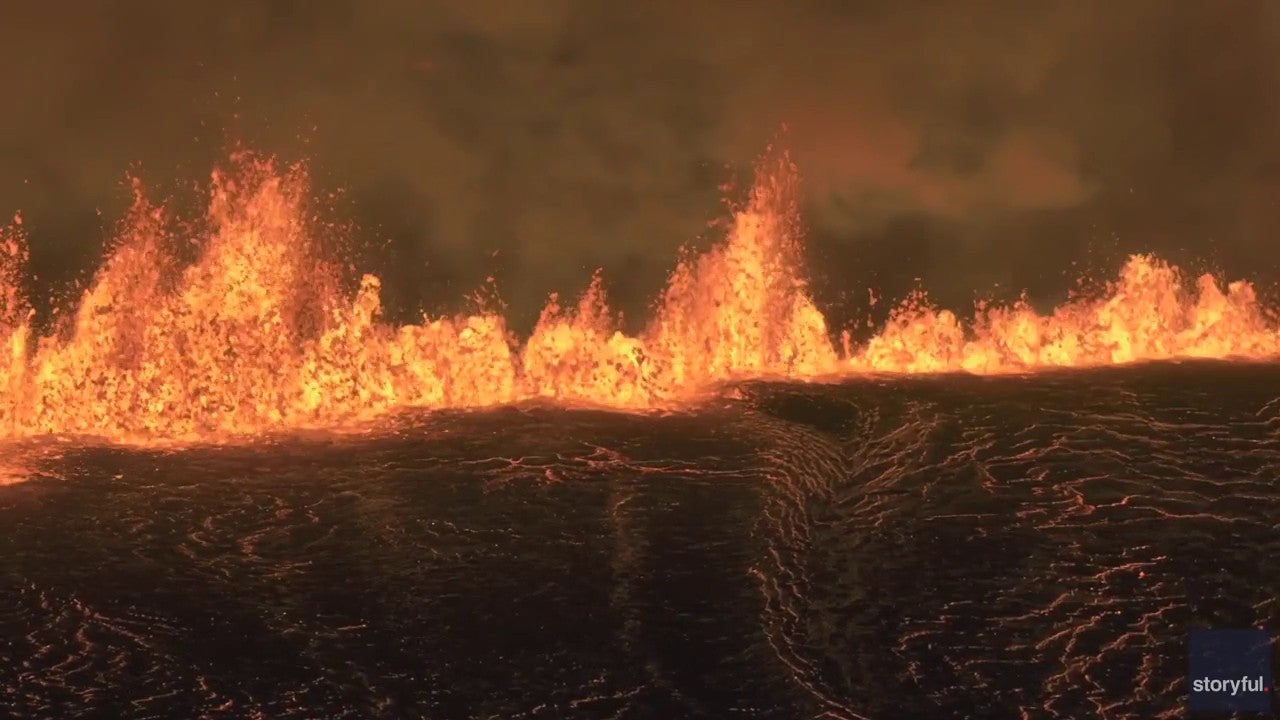
HAWAII’S KĪLAUEA VOLCANO ERUPTS FOR ITS 49TH EPISODE, SENDING FOUNTAINS OF LAVA INTO THE AIR
Despite its dramatic name, the Ring of Fire is not a single, continuous "ring" of erupting volcanoes. Instead, it is an area of tectonic plate boundaries where earthquakes and volcanic activity are much more common than in other parts of the world.
Many sections of the Ring of Fire may go years or even decades without a volcanic eruption, while earthquakes of varying sizes occur regularly throughout the region.
SEE IT: FIERY TORNADO-LIKE 'TEPHRA DEVIL' SWIRLS ON HAWAII'S KILAUEA VOLCANO
The term "Ring of Fire" can also create the impression that every earthquake in the region is linked to a volcano. But most earthquakes along the Ring of Fire are caused by the movement of tectonic plates, not by volcanic eruptions.
What's Your Reaction?
 Like
0
Like
0
 Dislike
0
Dislike
0
 Love
0
Love
0
 Funny
0
Funny
0
 Angry
0
Angry
0
 Sad
0
Sad
0
 Wow
0
Wow
0