















Two organizations team up to save cold-stunned sea turtles

Hundreds of frozen endangered sea turtles wash up on the shores of the East Coast every year as ocean temperatures plummet from winter conditions.
Most of them are nearly frozen to death, paralyzed and require immediate medical assistance. Some turtles even die from this experience.
PHOTOS: 25 COLD-STUNNED TURTLES RESCUED FROM CAPE COD BAY DURING BITTER ARCTIC BLAST
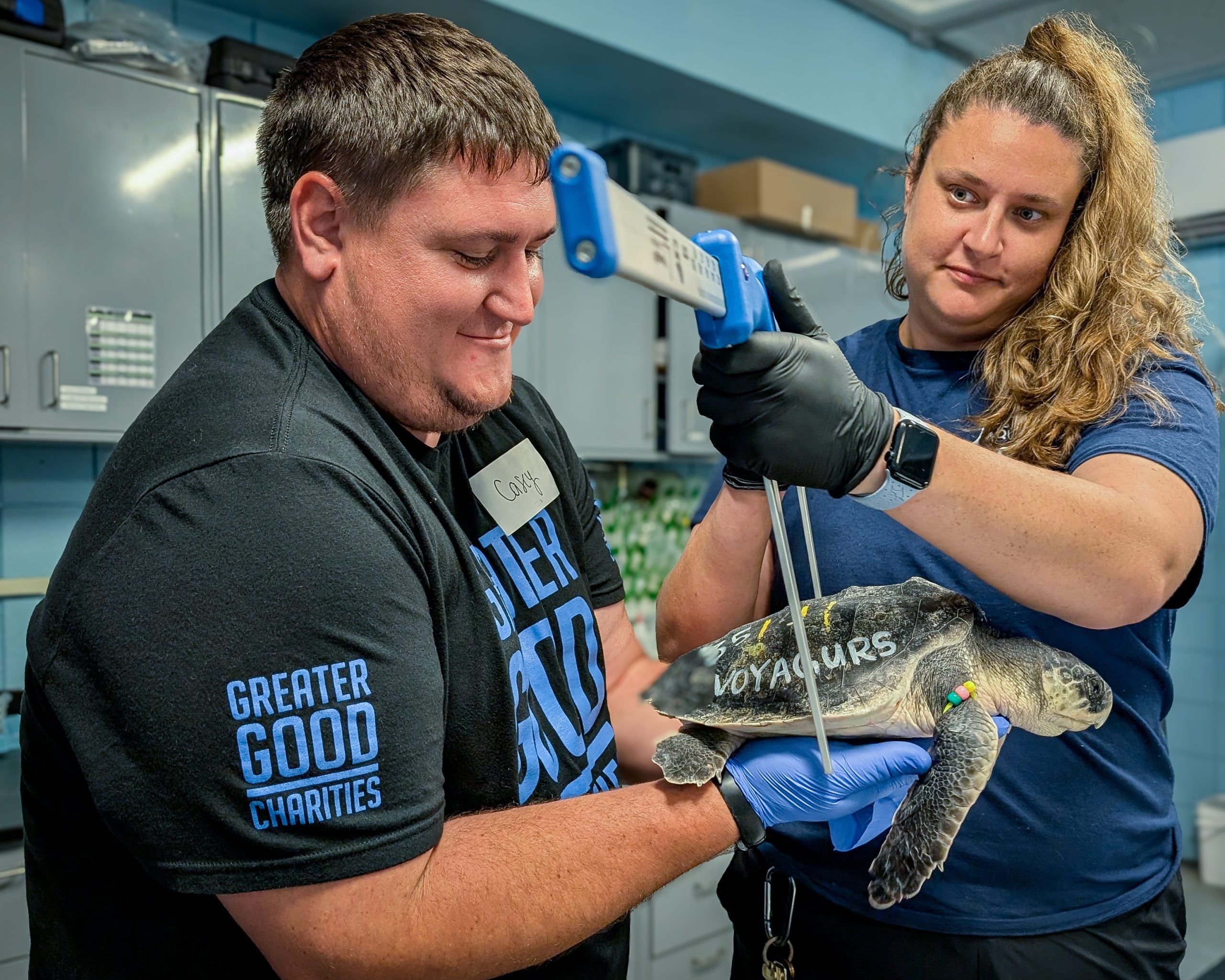
But two organizations are working together to save the turtles in time. In late fall, The Greater Good Charities, a global nonprofit, and the New England Aquarium collaborate to rescue and rehabilitate hundreds of stranded sea turtles on the Cape Cod coast.
"It was so cold and windy. I can't fathom how a turtle can sustain themselves in that water," Dr. Bryna Donnelly, executive vice president for Greater Good Charities, said. "And that's why all these volunteers literally just have to walk the beach twice a day, sometimes at each tide. Pick them up and then bring them to their first step of recovery at New England Aquarium."
Upon arrival, the turtles are gradually warmed up over three days. They are then given a physical exam, X-rays, respiratory assessment, wound care and a swim trial.
"They really don't look great when they get in," Adam Kennedy, director of rescue and rehabilitation at the New England Aquarium, said. "They're emaciated. These turtles look like they're dead."
WATCH: DRONE VIDEO CAPTURES THE WORLD’S LARGEST HATCHING OF BABY TURTLES
The most critically ill turtles remain long-term at the aquarium’s sea turtle hospital in Quincy, Massachusetts, where they receive specialized treatment for chronic conditions.
The stabilized turtles are transferred to partner organizations to continue rehabilitation, often traveling on emergency flights organized by Greater Good Charities to different centers across the country.
"I would love to take every single turtle here and care for them until we can send them back to the ocean, but logistically we just don't have the space here," Kennedy said.
By working closely with the National Oceanic and Atmospheric Administration’s (NOAA) Fisheries Service, the team is able to identify and secure facilities across the country that are willing to care for these cold-stunned turtles. More than 15 secondary rehabilitation facilities have stepped in this season to treat these animals.
This year alone, the New England Aquarium recovered over 470 sea turtles while over 174 have been transported to centers throughout the Southeastern U.S. At this time, 60 turtles remain at the hospital for long-term rehabilitation.
"It really does take a village," Dr. Donnelly said. "None of it would be possible without the collaboration of all these amazing organizations."
According to NOAA, cold-stunning is a condition when sea turtles become weak and inactive from the exposure to cold temperatures. Many of these turtles become lethargic, causing them to float to the surface.
Often referred to as "stranding season," this typically happens between November and early January when ocean temperatures fall below 50 degrees.
WHAT ARE 'COLD-STUNNED' SEA TURTLES?
When the animals are exposed to freezing temperatures long-term, they may develop secondary health problems, or die.
This has repeatedly occurred for decades in Cape Cod Bay, MA, Long Island Sound, NY, Pamlico Sounds, NC, and in other areas that endure extreme cold weather events.
For Cape Cod, "stranding season" came to a close on Dec. 21 after a week had gone by without any live turtles stranding.
Kennedy tells FOX Weather that with the warming of the Gulf of Maine, the aquarium has seen more turtles funnel into Cape Cod Bay each year. They predict that close to 1,000 turtles will experience cold-stunning by 2030.
"As turtles want to migrate south, as cold waters come in, they can't…because of the shape of Massachusetts with that kind of flexed arm." Kennedy said. "And for them…it's counter-intuitive to go north and east and loop around the Cape."
DOZENS OF SEA TURTLES RESCUED FROM FLORIDA BEACHES FOLLOWING HISTORIC WINTER BLAST
Since there is no way to prevent cold-stunning, Kennedy and Dr. Donnelly have made it their mission to utilize the resources of the Greater Good Charities and New England Aquarium to do what they can to protect these animals.
"You see these animals, they should be dead. They should be done on the beach. They've been cold for so long," Kennedy said. "And the fact that they survived that, they are amazing creatures."
What's Your Reaction?
 Like
0
Like
0
 Dislike
0
Dislike
0
 Love
0
Love
0
 Funny
0
Funny
0
 Angry
0
Angry
0
 Sad
0
Sad
0
 Wow
0
Wow
0