



















Vibrant discovery: Unique, salty clouds found on iconic 'Pink Planet'

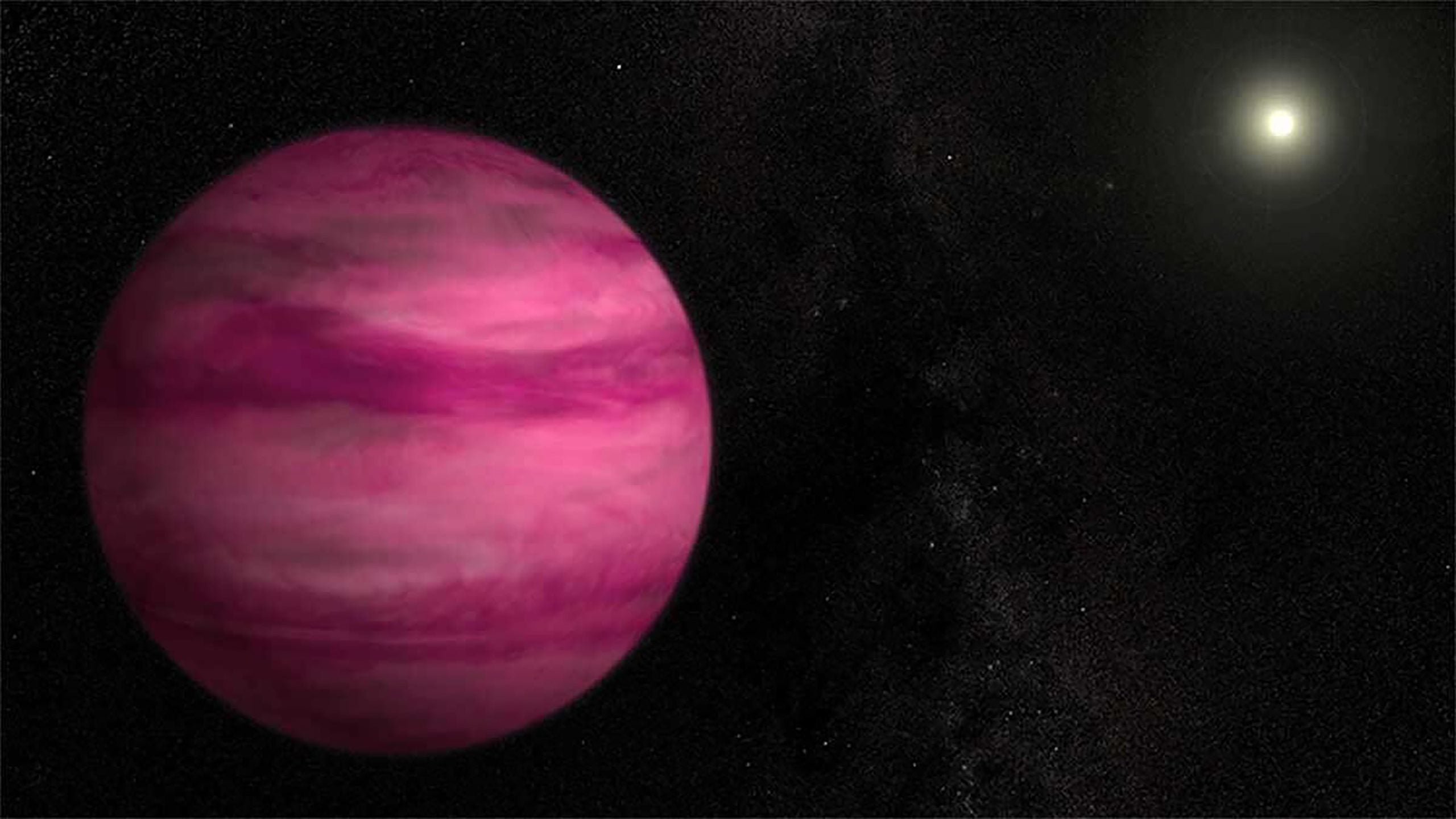
Scientists have discovered salt clouds surrounding the notable "Pink Planet," according to a new study released by astronomers at Northwestern University.
Discovered in 2013, the vibrant colored planet is one of the coldest known celestial objects ever directly imaged, and until recently has been too faint to examine from Earth’s light.
THE BEST CELESTIAL EVENTS IN 2026 YOU WON'T WANT TO MISS
However, recent observations by the James Webb Space Telescope have provided evidence for a theory scientists first hypothesized over 15 years ago: that the "Pink Planet" had salt clouds within its atmosphere.
"The Pink Planet is the coldest companion ever discovered using ground-based instruments," Northwestern’s Aneesh Baburaj, who led the study, said.
"Many teams all around the world performed follow-up observations to study its light, but it was too faint for ground-based instruments. That made it a perfect target," Baburaj continued. "When we finally obtained its spectrum, it immediately looked interesting. But once we started digging deeper into the data, we realized it was not like anything we had analyzed before."
JULY SKYWATCHING GUIDE: FROM PLANETARY CONJUNCTIONS TO CLOSE ENCOUNTERS IN SPACE
According to the study, the data from the planet revealed a mix of water vapor, methane, carbon dioxide, ammonia and other molecules.
When the researchers tried to reconstruct the simulated atmosphere, it did not match the planetary observations unless there were unique, salty features in them.
"We ran simulations with clouds, and the results aligned with what we know about cold planets," Baburaj said. "We tried three different types of clouds, and salt clouds fit best. When we accounted for salt clouds, it subdued the signature of molecules hidden deeper in the companion’s atmosphere. Then, the results became physically possible."
STRAWBERRY MOON DAZZLES THE NIGHT SKY AS FIRST FULL MOON OF THE SUMMER
NASA said the Pink Planet was first discovered in 2013, and is known as GJ 504 b. The exo planet orbits a sun-like star about 57 light years from Earth.
A plane traveling about 600 miles per hour would be there in 64 million years, NASA said.
"If we could travel to this giant planet, we would see a world still glowing from the heat of its formation with a color reminiscent of a dark cherry blossom, a dull magenta," NASA said.
Despite its nickname, researchers aren't certain that it is actually a planet.
SEE IT: DOZENS OF ACTIVE DUST DEVILS CAUGHT ON CAMERA SWIRLING ON MARS SURFACE
This discovery could help scientists unlock other mysteries about cold planets, such as Jupiter, which has clouds of ammonia ice.
"This is the first time we’ve found that salt clouds are critical to explaining the spectrum of an object," Baburaj said. "It’s a good reminder to account for clouds in our models."
What's Your Reaction?
 Like
0
Like
0
 Dislike
0
Dislike
0
 Love
0
Love
0
 Funny
0
Funny
0
 Angry
0
Angry
0
 Sad
0
Sad
0
 Wow
0
Wow
0