















10 important rocket launches in the history of the US spaceflight

The historic return-to-the-moon mission is just days away, as NASA plans to launch Artemis II on April 1.
This will mark the first time a crew flies aboard the Space Launch System (SLS) rocket and Orion spacecraft, and it will be the first crewed mission to travel around the moon since 1972.
FINAL PREPARATIONS UNDERWAY FOR THE LAUNCH OF NASA'S ARTEMIS II SPACE MISSION
If everything goes according to plan, this mission will be remembered in the history books.
However, Artemis II isn’t the only revolutionary space mission in America’s history. Here are a few rocket launches that stand out as pivotal moments in space exploration:
This marked a new chapter in spaceflight when the U.S. launched the first rocket from Cape Canaveral, Florida, known as Bumper 2.
This two-stage rocket combined a V-2 missile base with a WAC Corporal upper stage. It reached a record-breaking altitude of nearly 250 miles.
STARLINK LOSES CONTACT WITH SATELLITE ABOVE EARTH, BUT THE 'ANOMALY' POSES NO RISK
Bumper 2 rockets allowed NASA to measure attributes including air temperatures and cosmic ray impacts.
On May 5, 1961, Alan Shepard became the first American to journey into space aboard Freedom 7.
Although the flight lasted only about 15 minutes, it set the stage for future crewed missions.
SOLAR FLARE EVENT HAPPENS DAYS BEFORE ARTEMIS II MISSION. NASA SAID THEY'RE NOT CONCERNED ABOUT IT
Shepard’s flight was part of Project Mercury and helped NASA better understand how humans respond to spaceflight.
In 1962, John Glenn Jr. became the first American to orbit Earth during the Friendship 7 mission.
He circled the planet three times before the spacecraft splashed down safely in the ocean. The flight lasted 4 hours, 55 minutes and 23 seconds.
Apollo 8 is considered one of the most daring missions ever flown, marking the first time a crewed spacecraft orbited the moon.
SEE THE OBJECTS HUMANS LEFT BEHIND ON THE MOON
The three astronauts aboard Apollo 8 circled the moon 10 times before returning to Earth.
The mission lasted about six days, and the crew was later named Time magazine’s "Men of the Year" for 1968 upon their return.
On July 16, 1969, a 363-foot-tall Saturn V rocket launched Apollo 11 from Kennedy Space Center.
Apollo 11 became known as the first spaceflight crew to land on the moon.
EXTRAORDINARY ‘SUNGRAZER’ COMET COULD DAZZLE NYC SKYWATCHERS WITH A STUNNING SHOW
This mission was crewed by Commander Neil Armstrong, Command Module Pilot Michael Collins and Lunar Module Pilot Edwin "Buzz" Aldrin.
This set the stage for six more Apollo missions to carry humans to the moon.
NASA launched its first space station, Skylab, in May 1973.
It was occupied for about 24 weeks by three astronaut crews and allowed NASA to conduct long-duration human space research.
Skylab’s orbit eventually decayed, and it reentered Earth’s atmosphere on July 11, 1979, scattering debris over the Indian Ocean and parts of Western Australia.
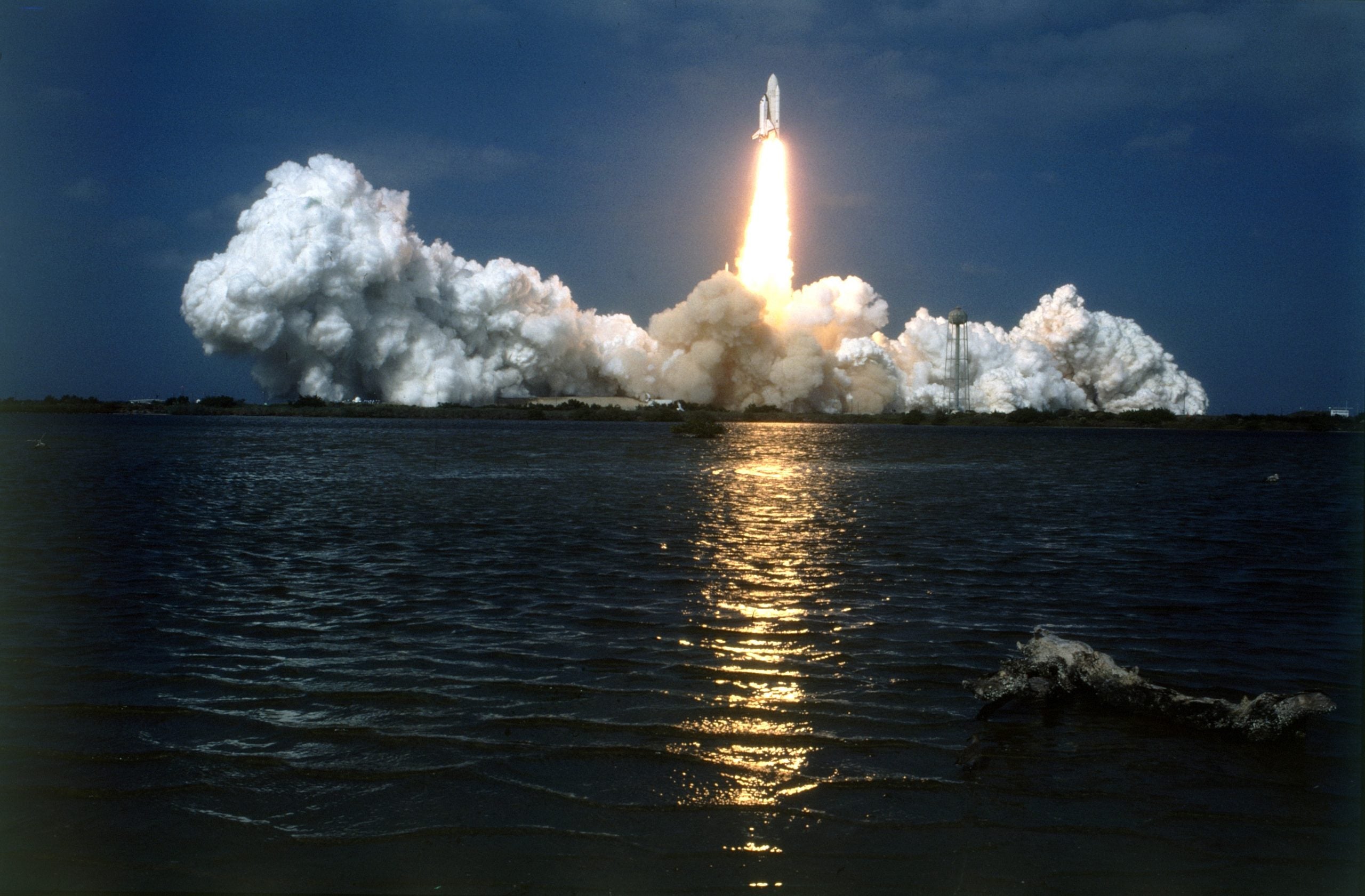
The first Space Shuttle launch took place on April 12, 1981—almost exactly 20 years after the first human spaceflight.
When the Space Shuttle Columbia flew into space, it started a new era. This was the first mission to use a reusable spacecraft.
NASA ANNOUNCES ARTEMIS II MISSION PHASES, PLANS FOR FUTURE ARTEMIS PROGRAM LAUNCHES
It was also the first time in history a new spacecraft was launched on its first flight with a crew aboard.
The Space Shuttle program went on to fly more than 100 missions over 30 years before ending in 2011.
In 1990, NASA launched the Hubble Space Telescope into orbit.
This mission became groundbreaking because it allowed scientists to observe the universe without atmospheric distortion, capturing sharp images of distant galaxies, nebulae and stars.
WATCH: NASA'S HUBBLE SPACE TELESCOPE CAPTURES RARE PROOF OF COMET BREAKING APART
It also helped researchers better understand black holes, the expansion of the universe and its age.
The launch of Hubble ultimately revolutionized modern astronomy.
The Falcon Heavy Launch marked a major milestone in modern spaceflight. It was the first mission to launch the powerful Falcon Heavy rocket.
This rocket became known as the most powerful operational rocket in the world, generating about five million pounds of thrust.
'FIREBALL SEASON' EXPLAINED: WHY METEORS ARE LIGHTING UP SKIES ACROSS THE COUNTRY
This mission captured global attention and demonstrated the potential of reusable heavy lift rockets.
Crew Dragon Demo-2 launched on May 30, 2020, marking a major milestone in space history as the first crewed mission flown by a private company, SpaceX.
Riding aboard the spacecraft Falcon 9, the astronaut traveled to the International Space Station.
This was the first time the U.S. launched astronauts into space since the end of its Space Shuttle program in 2011. After spending about two months in orbit, the crew safely returned to Earth on August 2, 2020.
What's Your Reaction?
 Like
0
Like
0
 Dislike
0
Dislike
0
 Love
0
Love
0
 Funny
0
Funny
0
 Angry
0
Angry
0
 Sad
0
Sad
0
 Wow
0
Wow
0